
The only way to stop feeling like an impostor is to stop thinking like an impostor.
—Dr. Valerie Young
Millions of capable people around the world — men and women — secretly worry they’re not as bright, talented, or qualified as everyone thinks they are.
It’s called impostor syndrome.
And it impacts individuals and organizations.
Fortunately, there is a solution.
%
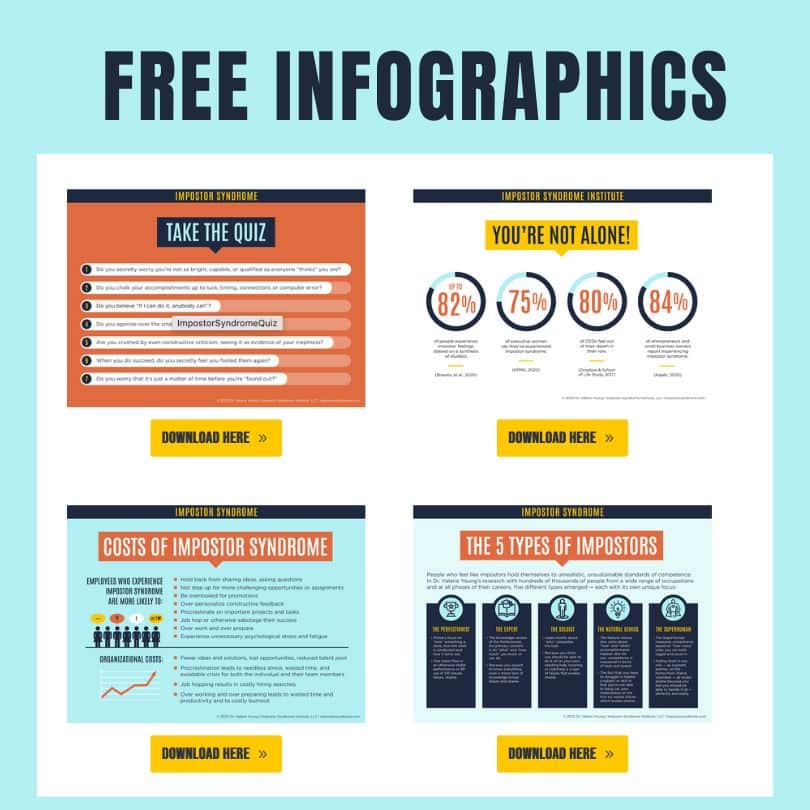
Studies by Gail Matthews, KMPG, Kajabi and Dropbox/School of Life found that 70-84% of people experience impostor syndrome.
CEOs and entry-level professionals, PhDs and first year college students, engineers and entrepreneurs, nurses and artists and many more report experiencing impostor feelings at some point in their life.
Impostor syndrome* is especially common among groups who experience social stereotypes about competence or intelligence and the pressure to represent their entire group.
Left unchecked, impostor syndrome is costly not only for individuals, but for their organizations as well.
* The term impostor phenomenon was coined in 1978. Despite references to impostor “syndrome” appearing as early as 1981 and its popular use today, it is not a psychological condition or diagnosis of any kind.
Impostor Syndrome Institute
Impostor Syndrome Institute (ISI) has been the foremost official provider of training, information, and tools since 1983.
Typical advice like “make a list of your accomplishments,” “get support, or “banish your inner critic” doesn’t work.
Nor does rebranding impostor syndrome as a “superpower.”
And if all it took was a pep talk… impostor syndrome would have disappeared long ago.
Impostor syndrome isn’t just an “interesting self-help topic.”
It’s a bottom-line issue negatively impacting productivity, advancement, retention, innovation, and health and well-being.
What Does Work?
“The only way to stop feeling like an impostor is to stop thinking like an impostor.” Dr. Valerie Young
Unlearning impostor syndrome requires learning how to think like someone who is genuinely humble but has never felt like an impostor.
A person we refer to as a Humble Realist™.
Fortunately, Humble Realist thinking can be learned and supported in the organization.
Unlearning impostor syndrome requires learning how to think like someone who is genuinely humble but has never felt like an impostor.
A person we refer to as a Humble Realist™.
Fortunately, Humble Realist thinking can be learned and supported in the organization.



If You Lead, Manage, Mentor, Coach, or Parent Other People You Need to Understand Impostor Syndrome
Our approach to overcoming impostor syndrome is based on the four decades of research, experience, and thought leadership by Dr. Valerie Young, widely recognized as the foremost expert on impostor syndrome.
Our proven educational solution has been delivered to over 500,000 people around the world at such diverse organizations as Google, JP Morgan, Pfizer, National Cancer Institute, NASA, and the NBA, as well as over 100 universities in the US, Canada, Japan, the UK, and Europe.