The only way to stop feeling like an impostor is to stop thinking like an impostor.
—Dr. Valerie Young
Millions of capable people around the world — men and women — secretly worry they’re not as bright, talented, or qualified as everyone thinks they are.
It’s called impostor syndrome.
And it impacts individuals and organizations.
Fortunately, there is a solution.
%
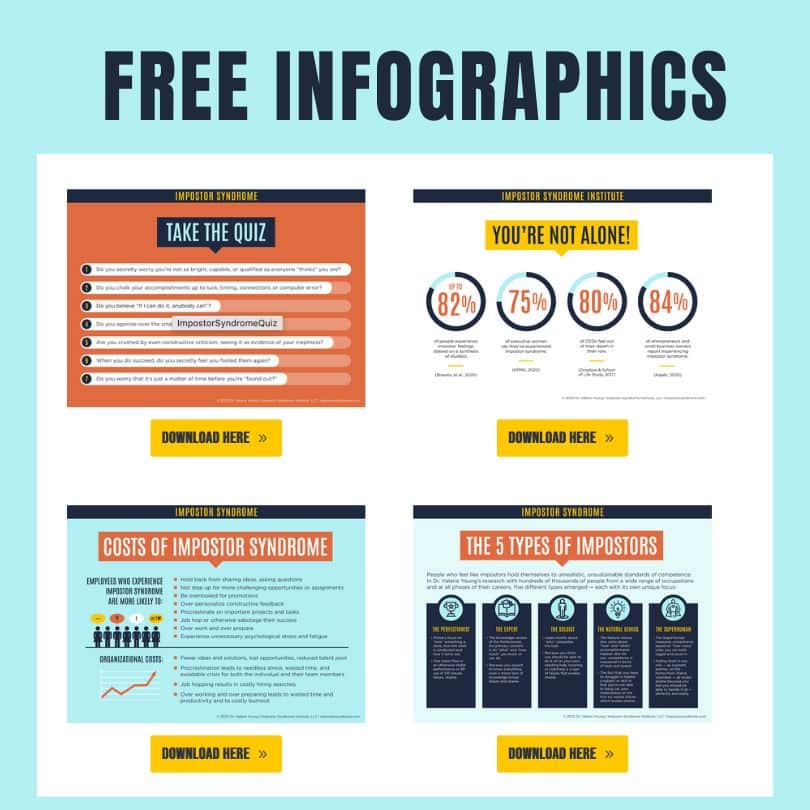
Studies by Gail Matthews, KMPG, Kajabi and Dropbox/School of Life found that 70-84% of people experience impostor syndrome.
CEOs and entry-level professionals, PhDs and first year college students, engineers and entrepreneurs, nurses and artists and many more report experiencing impostor feelings at some point in their life.
Impostor syndrome* is especially common among groups who experience social stereotypes about competence or intelligence and the pressure to represent their entire group.
Left unchecked, impostor syndrome is costly not only for individuals, but for their organizations as well.
* The term impostor phenomenon was coined in 1978. Despite references to impostor “syndrome” appearing as early as 1981 and its popular use today, it is not a psychological condition or diagnosis of any kind.
About Impostor Syndrome Institute
Impostor Syndrome Institute (ISI) has been the leading provider of training and tools for four decades. Its approach is grounded in the pioneering work of co-founder Dr. Valerie Young.
Whereas early remedies for the impostor phenomenon focused entirely on therapy, Young used the results of her doctoral research with professional women – over half of whom were women of color – to design the first educational intervention.
In addition to addressing both the internal and external sources of impostor feelings, the approach offered a proven process that empowered individuals to take charge of their own self- and pattern awareness and thus, transformation.
It also recognized the organizational sources and costs of impostor syndrome, something Young described in a 1985 cover article in The Executive Female magazine.
Since then, Dr. Young’s work underpinning ISI has been delivered to over half a million people worldwide.
This includes at more than 100 universities in the US, Canada, Japan, Europe, and the UK, and over 150 organizations, including Google, Pfizer, Apple, JP Morgan, Vanguard, Boeing, Johnson & Johnson, NASA, Visibility STEM Africa, National Cancer Institute, Scandinavian Society of Anesthesiology and Intensive Care Medicine, Women in Science, and the National Basketball Association.
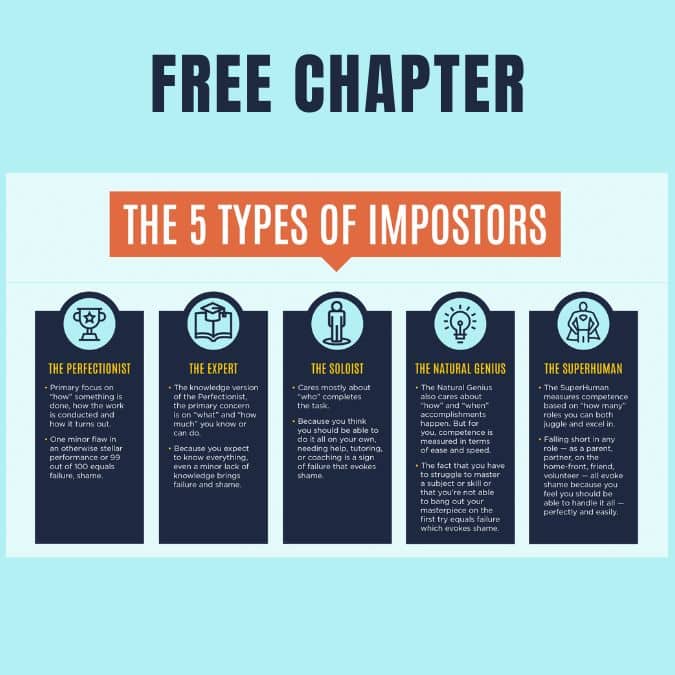
Testament to the global resonance of Young and ISI’s approach, her ground-breaking identification of competence distortions in the form of “the five types of impostor syndrome” (Perfectionist, Expert, Natural Genius, Soloist, Superhuman) in 1999 has over 3 million Google search results and her book on women and impostor syndrome has been translated into nine languages, including Turkish and Korean.
In recognition of her position as the leading thought leader, Young was the only non-psychologist and non-academic whom the American Psychological Association invited to contribute a chapter to the first research-based book on impostor phenomenon.
The Impostor Syndrome Institute builds on this unparalleled experience to provide free resources to individuals and organizations and to train coaches and HR specialists to effectively address this multifaceted, highly nuanced topic with clients and employees.
What Does Work?
“The only way to stop feeling like an impostor is to stop thinking like an impostor.” Dr. Valerie Young
Unlearning impostor syndrome requires learning how to think like someone who is genuinely humble but has never felt like an impostor.
A person we refer to as a Humble Realist™.
Fortunately, Humble Realist thinking can be learned and supported in the organization.

Unlearning impostor syndrome requires learning how to think like someone who is genuinely humble but has never felt like an impostor.
A person we refer to as a Humble Realist™.
Fortunately, Humble Realist thinking can be learned and supported in the organization.
If You Lead, Manage, Mentor, Coach, or Parent Other People You Need to Understand Impostor Syndrome
Our approach to overcoming impostor syndrome is based on the four decades of research, experience, and thought leadership by Dr. Valerie Young, widely recognized as the foremost expert on impostor syndrome.
Our proven educational solution has been delivered to over 500,000 people around the world at such diverse organizations as Google, JP Morgan, Pfizer, National Cancer Institute, NASA, and the NBA, as well as over 100 universities in the US, Canada, Japan, the UK, and Europe.